Custom business app – how does It improve work?
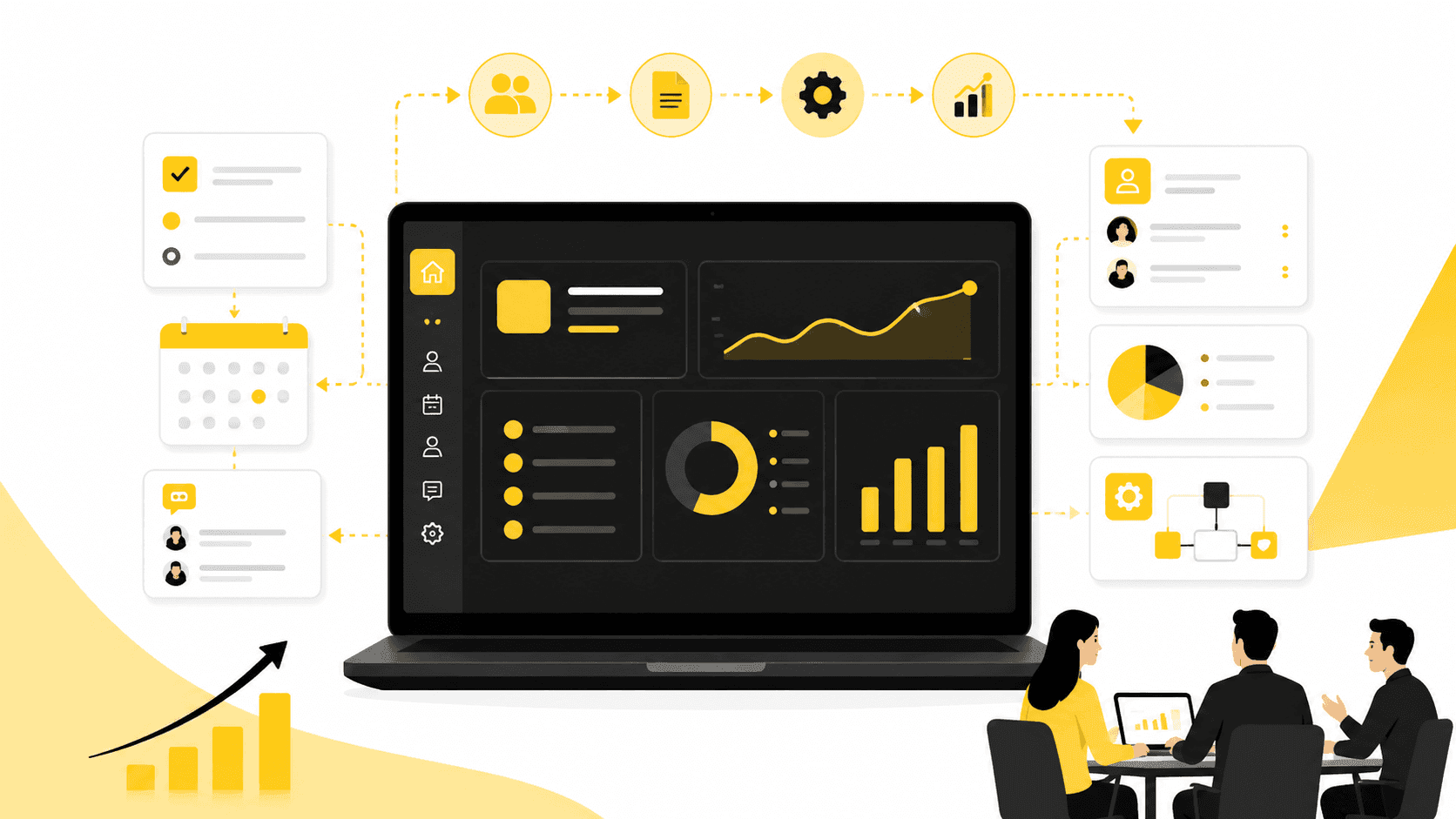

Excel with a hundred tabs, Slack full of disappearing messages, a CRM that does not communicate with the warehouse, and an employee who rewrites the same data from one system to another every month. Sounds familiar? A custom business application solves exactly this problem, it replaces tool chaos with one system tailored to specific processes.In this article, I will show how dedicated software can realistically shorten working time, reduce costs, and give your company a competitive advantage. I will also explain when it is actually worth ordering a custom application and when a ready-made SaaS solution is enough.
- 1. What Is a custom dedicated business application?
- 2. 10 Benefits a custom application brings to a company
- 3. Benefits a custom application brings to a company
- 4. Benefits a custom application brings to a company
- 5. Ready-made software or a custom application – which should you choose?
- 6. For which companies is it worth Implementing dedicated software?
- 7. What does the custom application development process look like?
- 8. Summary
What Is a custom dedicated business application?
A custom application is software designed and developed for the specific needs of one company. Unlike ready-made SaaS tools, such as CRM, ERP, or project management systems, it does not try to be universal. It does exactly what your business needs no less and no more.
In practice, such an application can take the form of:
- a web-based system accessible from a browser,
- a mobile app for field employees,
- an admin panel for data management,
- a backend integration connecting existing systems.
Web applications are chosen most often because they work on every device, do not require installation, and can be easily updated centrally.
10 Benefits a custom application brings to a company

1. Automation of Repetitive Processes
Every company has tasks that are performed in the same way every day: issuing invoices, generating reports, sending emails to clients, or updating inventory levels. A dedicated application takes over these tasks entirely or to a large extent. Example: instead of spending three hours a day manually preparing a sales report, the application generates it automatically at 7:00 a.m. and sends it to the inboxes of the right people.
2. Saving Employees’ Time
According to various studies, the average office employee loses from 1.5 to 3 hours a day on administrative tasks that could be automated. In a company employing 20 people, this means 30–60 hours of work per day recovered for actual substantive work.
3. Eliminating Human Error
A person can always make a mistake when manually copying data. An application does not.
Eliminating errors means not only fewer corrections, but above all:
- fewer customer complaints,
- consistent data in reports,
- compliance with audit procedures,
- lower legal and tax risk.
Benefits a custom application brings to a company

- Centralizing Data in One Place When customer information is stored in the CRM, invoices in accounting software, documents on a drive, and arrangements in emails, finding anything can take forever. A custom application connects this data into one consistent view. Every employee sees exactly what they need for their work in the same place.
- Better Communication and Team Collaboration Dedicated software makes it possible to build document workflow, a task system, project statuses, and notifications into one interface. Employees stop wasting time asking, “What is the current status?” — because they can see it themselves.
- Scalability as the Company Grows Ready-made tools often become limiting as a company grows. Either they lack certain features, or a license for 100 users costs a fortune, or the system cannot handle larger volumes of data. A custom application grows together with the business — exactly in the way you need.
- Integrations with Existing Systems A good tailor-made application does not replace everything you already have — it connects it all into one coherent system. It can integrate via API with accounting software, such as Comarch, Symfonia, or iFirma, e-commerce platforms, such as Shopify, WooCommerce, or PrestaShop, shipping systems, data warehouses, or marketing tools.
Benefits a custom application brings to a company
- Competitive Advantage If your company has a process that works differently from the competition — and this is the reason why customers choose you — ready-made software will never fully reflect it. A dedicated application allows you to encode your advantage into a tool that your competitors do not have.
- Greater Control Over Data Security When choosing SaaS, you agree to the conditions and security level imposed by the provider. With your own application, you decide where the data is stored, who has access to it, what backup procedures are in place, and how compliance with GDPR and internal security policies is handled.
- ROI – Real Return on Investment lthough a dedicated application requires a larger initial investment than a SaaS subscription, in the medium and long term it usually pays off faster. No monthly per-user fees, lower costs of errors, and savings in working hours all contribute to a specific, measurable return.
Ready-made software or a custom application – which should you choose?

This is not an ideological question. Each solution has its place.
Ready-made SaaS software works well when:
- your process is standard, such as typical accounting or simple sales,
- you have a small team and a limited starting budget,
- you want to launch within a few days,
- you do not plan to heavily customize the tool.
A custom application will be a better choice when: - your processes are specific to your industry or company,
- you use many tools that need to be connected,
- ready-made solutions force you to change the way you work,
- annual SaaS subscriptions exceed the cost of custom software,
- you have a specific process advantage that you want to “encode.”
The best results usually come from a hybrid approach — ready-made tools where there is no need to reinvent the wheel, and dedicated software where the company truly stands out in terms of its processes.
For which companies is it worth Implementing dedicated software?

From our experience, a web application for business works particularly well in:
- manufacturing companies – order management, production planning, batch tracking,
- logistics companies – route planning, cost calculation, integrations with carriers,
- agencies and service companies – time tracking, project billing, invoicing,
- e-commerce businesses – integrations between the online store, warehouse, couriers, and accounting,
- companies with field employees – mobile applications for requests, reporting, and geolocation,
- the medical and legal sectors – where regulatory compliance is critical.
What does the custom application development process look like?

A standard project takes place in several stages:
- Analysis and discovery workshop – mapping processes, identifying bottlenecks, and prioritizing features.
- UX/UI design – wireframes, prototypes, and user flows.
- Pricing and schedule – a specific budget and timeline prepared after gathering the requirements.
- Iterative development – every 2–4 weeks, you see a working version of the application.
- Testing and implementation – including team training and data migration.
- Support and further development – the application evolves together with the company and is gradually expanded.
The most common mistake? Trying to order “everything at once.” It is much better to launch an MVP with the most important features, test it in practice, and only then expand it.
Summary
A custom application for business is not an extravagance reserved for corporations — it is a tool that, at the right moment, can significantly increase team efficiency, reduce operating costs, and create a competitive advantage. The key is to define the problem well, start with an MVP, and choose a technology partner who understands business, not just code. If you are wondering whether your company is ready for custom software, start with a simple exercise: write down the five most time-consuming tasks in your company. If at least three of them are repetitive and require “connecting” several tools, you already have a strong argument for discussing a dedicated application.

Wiktoria Jarmuszczak
CCOPartners
Outpace the competition!
Contact us and we will help you to achieve your goals!
